How to Order Food in Mexico—and Understand the Reply
Learn how to order food in Mexico, understand common questions from your server, and ask for clarification—with short Spanish dialogues and English translations.
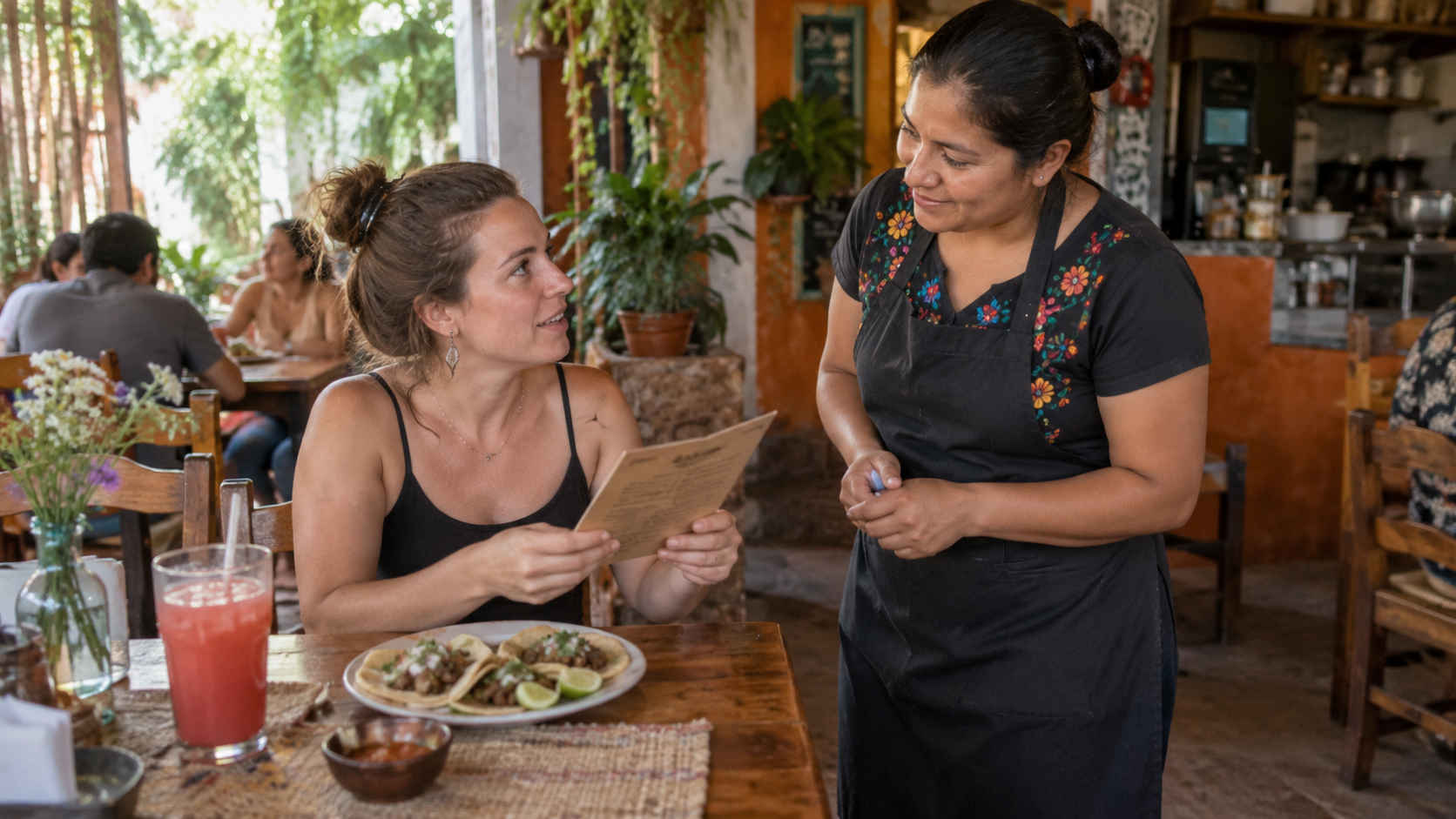
Ordering food in Mexico is easier when you prepare for both sides of the conversation: what to say and what your server might ask next.
Start with this:
“Me da dos tacos de pollo, por favor.”
“Could I have two chicken tacos, please?”
Then be ready for a question about toppings, drinks, or whether you want your food for here or to go.
This guide gives you short exchanges to practice, ways to handle an unexpected reply, and a phrase card to save on your phone. Examples vary by restaurant and menu.
Place your order
Start with one flexible phrase
“Me da…, por favor” is a common, polite way to order. Add a greeting and name the item you want:
- “Buenas tardes. Me da una quesadilla, por favor.”
“Good afternoon. Could I have a quesadilla, please?” - “Me da dos tacos de pollo, por favor.”
“Could I have two chicken tacos, please?” - “Me da una botella de agua, por favor.”
“Could I have a bottle of water, please?”
You can also say “Quisiera…”, meaning “I would like…”
If you cannot pronounce a dish, point to it on the menu:
“Quisiera este plato, por favor.”
“I would like this dish, please.”
Check whether the price is for one item or a whole order. When it is unclear, ask:
“¿Cuántos tacos vienen en la orden?”
“How many tacos come in an order?”
Ask about ingredients
A translated dish name may not tell you what comes with it. Ask about the detail that matters to you:
- “¿Qué lleva este plato?”
“What ingredients are in this dish?” - “¿Viene con arroz?”
“Does it come with rice?” - “¿Tiene carne?”
“Does it contain meat?” - “¿Se puede sin queso?”
“Can it be made without cheese?” - “Sin cebolla, por favor.”
“Without onion, please.”
If you need to communicate a food allergy, explicitly explain the allergy and confirm ingredients and preparation with staff. A request to leave off an ingredient does not establish that a meal is safe for an allergy.
Ask about spicy food
“¿Pica?” means “Is it spicy?”
The answer is subjective. If you want to avoid chili, ask a more specific question:
“¿Se puede preparar sin chile?”
“Can it be prepared without chili?”
You can also request:
“La salsa aparte, por favor.”
“The sauce on the side, please.”
A dish may already contain chili in its marinade or sauce. Asking for salsa on the side only addresses the salsa served separately.
Understand your server’s questions
Listen for the choice you need to make. You do not have to understand every word to give a useful answer.
“¿Qué le traigo?” — What can I get you?
Say the dish or drink you want:
“Una quesadilla, por favor.”
“A quesadilla, please.”
You might also hear “¿Qué va a querer?”, another way to ask what you would like.
“¿De tomar?” — Anything to drink?
Name a drink from the menu, or ask for:
“Una botella de agua natural, por favor.”
“A bottle of still water, please.”
“Agua mineral” commonly refers to sparkling water in Mexico. If you want to make your preference explicit, say “sin gas” for still or “con gas” for sparkling.
“¿Para aquí o para llevar?” — For here or to go?
Choose one:
- “Para aquí, por favor.” — “For here, please.”
- “Para llevar, por favor.” — “To go, please.”
Listen & practice
¿Para aquí o para llevar?
For here or to go?
Computer-generated voice. Accent and availability vary by device.
“¿Con todo?” — With all the usual toppings?
What “everything” includes depends on the food and establishment.
If you are unsure, ask:
“¿Qué lleva?”
“What comes on it?”
Listen & practice
¿Qué lleva?
What is in it?
Computer-generated voice. Accent and availability vary by device.
Then name your preference:
“Con cilantro, pero sin cebolla, por favor.”
“With cilantro, but without onion, please.”
“¿Algo más?” — Anything else?
If your order is complete:
“Nada más, gracias.”
“That’s all, thank you.”
Listen & practice
Nada más, gracias.
That’s all, thank you.
Computer-generated voice. Accent and availability vary by device.
Practice a short conversation
At a taquería
In this example, the traveler chooses tacos, specifies toppings, and orders a drink. Adapt the food to the actual menu.
Server: Hola, ¿qué le damos?
Hello, what can we get you?
You: Dos tacos de pollo, por favor.
Two chicken tacos, please.
Server: ¿Con cebolla y cilantro?
With onion and cilantro?
You: Con cilantro, pero sin cebolla, por favor.
With cilantro, but without onion, please.
Server: ¿Para aquí o para llevar?
For here or to go?
You: Para aquí.
For here.
Server: ¿Algo de tomar?
Anything to drink?
You: Una botella de agua, por favor.
A bottle of water, please.
Notice how short the answers are. Your goal is to make your choices understood, not to deliver a perfect speech.
At a sit-down restaurant
If you need more time with the menu, say:
“Necesitamos unos minutos más, por favor.”
“We need a few more minutes, please.”
When you are ready, the exchange might sound like this:
Server: ¿Ya saben qué van a pedir?
Do you know what you would like to order?
You: Sí. Para mí, el pescado, por favor.
Yes. For me, the fish, please.
Server: ¿Y de tomar?
And to drink?
You: Agua mineral, por favor.
Sparkling water, please.
Server: ¿Algo más?
Anything else?
You: Por ahora, nada más. Gracias.
Nothing else for now. Thank you.
Want a recommendation? Ask “¿Qué nos recomienda?” — “What do you recommend?”
Expect a longer reply. You can ask the server to point to the dish on the menu while explaining.
What to say when you don’t understand
An unfamiliar reply is a normal part of the experience. Prepare a way to slow the conversation down:
- “Perdón, no entendí.”
“Sorry, I didn’t understand.” - “¿Puede repetir, por favor?”
“Can you repeat, please?”
Listen & practice
¿Puede repetir, por favor?
Can you repeat, please?
Computer-generated voice. Accent and availability vary by device.
- “Más despacio, por favor.”
“More slowly, please.” - “¿Me puede mostrar en el menú?”
“Can you show me on the menu?”
You can also repeat the part you understood as a question.
Server: ¿Quiere la orden de tres o de cinco?
Would you like the order of three or five?
You: Perdón, ¿tres o cinco tacos?
Sorry, three or five tacos?
Server: Sí.
Yes.
You: Tres, por favor.
Three, please.
Confirming one detail is enough to move the conversation forward. If you still cannot understand, pointing to the menu or using a translation app can help.
Ask for the bill and pay
When you are ready to leave:
“La cuenta, por favor.”
“The bill, please.”
Listen & practice
La cuenta, por favor.
The bill, please.
Computer-generated voice. Accent and availability vary by device.
These questions cover common payment needs:
- “¿Aceptan tarjeta?”
“Do you accept cards?” - “¿Puedo pagar en efectivo?”
“Can I pay in cash?” - “¿Nos puede cobrar por separado?”
“Can we pay separately?” - “Disculpe, ¿qué es este cargo?”
“Excuse me, what is this charge?”
If paying by card is essential, check before ordering. Ask about separate payments early, since the restaurant may have its own process.
For an unclear charge, point to the item on the bill and ask one question at a time.
Save this quick phrase card
Take a screenshot of these essentials before your meal:
- Order: “Me da…, por favor.”
Could I have…, please? - Choose: “Para aquí” / “Para llevar.”
For here / To go. - Check ingredients: “¿Qué lleva?”
What is in it? - Clarify: “¿Puede repetir, por favor?”
Can you repeat, please? - Ask for help: “¿Me puede mostrar en el menú?”
Can you show me on the menu? - Finish ordering: “Nada más, gracias.”
That’s all, thank you. - Ask for the bill: “La cuenta, por favor.”
The bill, please.
Practice before your trip
Try this five-minute exercise:
- Choose a meal. Use a real menu and pick something you would eat.
- Say your order aloud. Start with “Me da…” and include “por favor.”
- Answer three follow-up questions: “¿Para aquí o para llevar?”, “¿De tomar?”, and “¿Algo más?”
- Practice getting stuck. Say “¿Puede repetir, por favor?” without looking at the text.
- Repeat with a different order. Change the food, quantity, and drink.
A translation app helps you look up unfamiliar words. This exercise helps you prepare for the back-and-forth of ordering.
If you want guided audio practice, Rocket Spanish includes a lesson called “1.3 Placing an Order”, centered on ordering a hot drink at a café. It offers a related situation to practice alongside the restaurant examples in this guide.
For a broader preparation routine, read Learn Spanish for Mexico in 30 Days: A Practical Travel Plan.
Frequently asked questions
Can I order food in Mexico if I don’t speak Spanish?
Yes. You can point to a menu item and say “Este, por favor” (“This one, please”). A little preparation helps with follow-up questions: learn “¿Para aquí o para llevar?” (“For here or to go?”) and “¿Algo más?” (“Anything else?”). If you don’t understand, ask “¿Puede repetir, por favor?” or use a translation app.
What does “¿Con todo?” mean when ordering tacos?
It means “With all the usual toppings?” The toppings depend on the taco and the establishment, so ask “¿Qué lleva?” (“What comes on it?”) if you’re unsure. To request a change, say something like “Sin cebolla, por favor” (“Without onion, please”).
How do I ask for the bill in Spanish?
Say “La cuenta, por favor” (“The bill, please”). To ask whether you can pay by card, say “¿Aceptan tarjeta?” If paying by card is essential, check before ordering.