Spanish Phrases for Your Airbnb in Mexico: Check-In, Problems and Checkout
Communicate with your Airbnb host in Mexico using practical Spanish phrases, ready-to-send messages, and examples of replies about keys, hot water, Wi-Fi, and checkout.
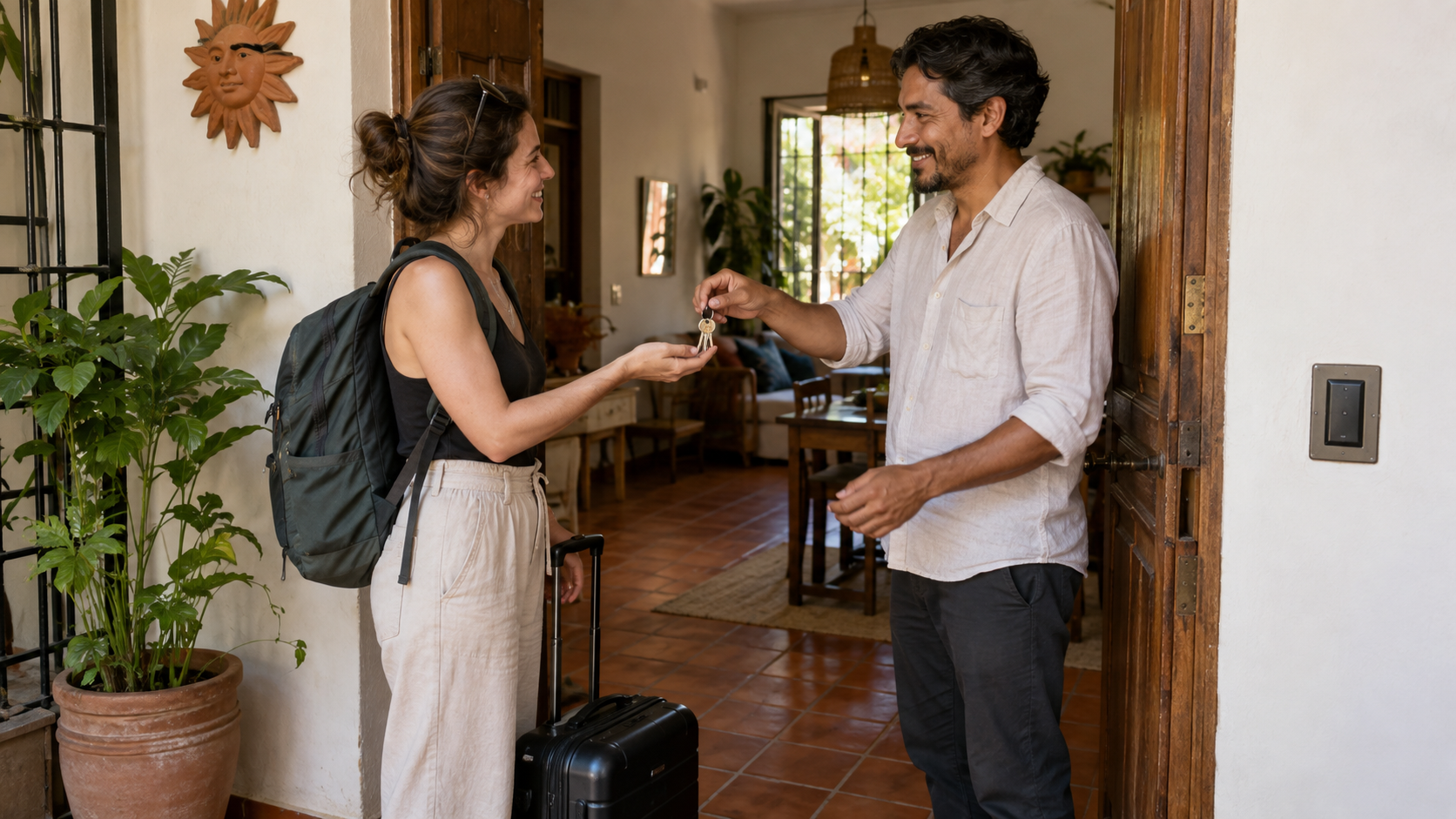
Arriving at your Airbnb in Mexico is easier when you know what to ask—and what your host might say back. Start with three useful questions: “¿Cómo entro?” (How do I get in?), “¿Dónde recojo las llaves?” (Where do I pick up the keys?), and “¿Cuál es la contraseña del wifi?” (What’s the Wi-Fi password?).
This guide gives you short Spanish messages you can adapt, possible replies, and follow-up questions for common situations during your stay.
Before you arrive: confirm how to get inside
Confirm the address, your arrival time, and how you will enter the property. If you need to arrive early, ask whether it is possible rather than assuming the accommodation will be ready.
Send your arrival time
“Hola, soy [name]. Tengo una reservación para el [date]. Llegaré aproximadamente a las [time]. ¿Cómo será la entrega de llaves?”
Hello, I’m [name]. I have a reservation for [date]. I’ll arrive at approximately [time]. How will the key handover work?
Write the month out and include “a. m.” or “p. m.” when needed to make your message clear.
Your host might reply:
“Avíseme cuando esté cerca.”
Let me know when you’re nearby.
You can answer:
“Claro, le aviso cuando esté a unos quince minutos.”
Of course. I’ll let you know when I’m about fifteen minutes away.
Ask about early arrival
“¿Sería posible dejar las maletas antes de la hora de entrada?”
Would it be possible to leave our bags before check-in time?
This asks about storing luggage, which is different from asking to use the accommodation early.
If you want early access, ask:
“¿Sería posible entrar a las doce del día?”
Would it be possible to check in at noon?
At the entrance: find the keys and the right door
An address may take you to the building without explaining how to reach the apartment. Ask about the entrance, apartment number, and any access code you need.
Ask where to collect the keys
“Ya llegué. Estoy frente a la entrada. ¿Dónde recojo las llaves?”
I’ve arrived. I’m in front of the entrance. Where do I pick up the keys?
Your host might reply:
“Las llaves están en una cajita junto a la puerta.”
The keys are in a small box next to the door.
A useful follow-up is:
“Gracias. ¿Me puede enviar el código y una foto de la cajita?”
Thank you. Could you send me the code and a photo of the box?
Explain that the door will not open
“Estoy en la puerta del departamento, pero el código no funciona. ¿Me puede ayudar?”
I’m at the apartment door, but the code isn’t working. Could you help me?
Be specific about which door you mean. “La entrada del edificio” means the building entrance; “la puerta del departamento” means the apartment door.
You may see “departamento” or “depa” used for an apartment in messages in Mexico.
Once inside: ask about Wi-Fi and house instructions
Ask about anything you need to use but cannot figure out from the host’s instructions.
Connect to the right Wi-Fi network
“¿Cuál es el nombre de la red y la contraseña del wifi?”
What are the Wi-Fi network name and password?
If the network appears but you cannot connect:
“La red aparece, pero no puedo conectarme. ¿Me puede confirmar la contraseña?”
The network appears, but I can’t connect. Could you confirm the password?
If you are connected but pages will not load:
“Estoy conectado al wifi, pero no tengo acceso a internet.”
I’m connected to the Wi-Fi, but I don’t have internet access.
These messages describe different problems and help your host understand what to check.
Ask where to put the trash
“¿Dónde se deja la basura?”
Where should I put the trash?
Your host might say:
“En los botes del patio.”
In the bins in the courtyard.
If you do not know which courtyard they mean:
“¿Me puede mandar una foto o indicar cómo llegar?”
Could you send me a photo or explain how to get there?
Report a problem clearly
A useful message has three parts: what is happening, where it is happening, and what help you need.
Keep the first message short. Add a photo when it helps explain the problem.
There is no hot water
“Hola. No sale agua caliente en la regadera. ¿Me puede indicar si hay algún paso que deba seguir?”
Hello. There’s no hot water coming out of the shower. Could you tell me whether there’s a step I need to follow?
“Regadera” means shower in this context. Your host may mention the “calentador” or “boiler,” meaning the water heater.
Ask for clear instructions or assistance if you do not understand how something works.
“¿Podría venir alguien a revisarlo?”
Could someone come and check it?
The air conditioning is not working
“El aire acondicionado de la recámara no enciende. ¿Me puede ayudar?”
The air conditioning in the bedroom won’t turn on. Could you help me?
“Recámara” means bedroom. You may also hear “habitación” or “cuarto.”
If the unit turns on but does not cool, use:
“El aire acondicionado enciende, pero no enfría.”
The air conditioning turns on, but it doesn’t cool.
Ask when someone can come
“¿A qué hora podría venir alguien a revisarlo? Estaremos aquí hasta las dos de la tarde.”
What time could someone come and check it? We’ll be here until two in the afternoon.
If your host replies “ahorita,” and you need to plan your day, ask for an approximate time:
“Gracias. ¿Como en cuántos minutos?”
Thank you. In about how many minutes?
“Ahorita” does not always give you a precise timeframe. Confirming a time is more useful than guessing.
When you do not understand your host
You do not need to understand every word to keep the conversation moving. Ask for the instruction in a form you can follow.
Ask for a written message
“¿Me lo puede escribir por mensaje, por favor?”
Could you write it in a message, please?
This is useful when someone gives you directions in person or sends a voice message that is difficult to follow.
Confirm one instruction at a time
“Entonces, dejo las llaves en la mesa y cierro la puerta al salir, ¿correcto?”
So, I leave the keys on the table and close the door when I leave, correct?
Repeating the instruction in your own words gives your host a chance to correct a misunderstanding.
A translation app can help you read a message. For important details such as access instructions or departure times, confirm what you understood with your host.
Before checkout: confirm the time and the keys
Check the departure instructions before your final morning so you have time to ask questions.
Confirm the departure time
“Hola. Para confirmar, ¿a qué hora debemos salir mañana?”
Hello. Just to confirm, what time do we need to leave tomorrow?
If you want to request a later departure:
“¿Sería posible salir a la una de la tarde? Entendemos si no es posible.”
Would it be possible to check out at one in the afternoon? We understand if that isn’t possible.
Wait for confirmation before changing your plans.
Ask where to leave the keys
“¿Dónde dejamos las llaves al salir?”
Where should we leave the keys when we leave?
Your host might reply:
“Déjenlas sobre la mesa y cierren la puerta.”
Leave them on the table and close the door.
If anything is unclear, confirm it before leaving the keys inside.
Send a final message
“Ya salimos y dejamos las llaves donde nos indicó. Muchas gracias por la estancia.”
We’ve left and put the keys where you instructed. Thank you very much for the stay.
Practice a short conversation before your trip
Try this exchange out loud:
Guest: “Hola, ya llegué. ¿Dónde recojo las llaves?”
Hello, I’ve arrived. Where do I pick up the keys?
Host: “Están en una cajita junto a la entrada.”
They’re in a small box next to the entrance.
Guest: “Gracias. ¿Me puede enviar el código?”
Thank you. Could you send me the code?
Host: “Sí, se lo mando por mensaje.”
Yes, I’ll send it to you in a message.
Guest: “Perfecto, muchas gracias.”
Perfect, thank you very much.
Practice in three steps:
- Read the guest’s lines aloud.
- Cover the English and check that you understand each Spanish sentence.
- Change one detail, such as asking for the Wi-Fi password instead of the access code.
The goal is to recognize a useful reply and know what to ask next. Start with the situations you are most likely to face during your own stay.
Quick reference: Spanish phrases for your Airbnb
| English | Spanish | Usage in Mexico |
|---|---|---|
| Where do I pick up the keys? | ¿Dónde recojo las llaves? | Ask before arriving or when you reach the entrance. |
| The code isn’t working | El código no funciona | Explain a problem with the entrance keypad or lockbox |
| What’s the Wi-Fi password? | ¿Cuál es la contraseña del wifi? | Ask your host for the wireless network password. |
| There’s no hot water in the shower. | No sale agua caliente en la regadera. | “Regadera” refers to the shower. |
| The bedroom air conditioning won’t turn on. | El aire acondicionado de la recámara no enciende. | “Recámara” means bedroom. |
| Could you write it in a message? | ¿Me lo puede escribir por mensaje? | Ask for written instructions when spoken directions are unclear. |
| What time do we need to check out? | ¿A qué hora debemos salir? | Confirm the departure time with your host. |
| Where should we leave the keys? | ¿Dónde dejamos las llaves? | Confirm the key handover before leaving. |
Frequently asked questions
Can I stay in an Airbnb in Mexico if I don’t speak Spanish?
Yes, but the language your host speaks will vary. Before arrival, ask for written check-in instructions and confirm how to collect the keys. A translation app can help with messages, while a few Spanish phrases make it easier to ask questions in person.
What should I say if I can’t get into my Airbnb?
Write: “Hola, ya llegué, pero no puedo entrar. ¿Me puede ayudar?” This means, “Hello, I’ve arrived, but I can’t get in. Could you help me?” Explain whether you are at the building entrance or the apartment door. If the access code isn’t working, add: “El código no funciona.”
What does “ahorita” mean when my host says it?
“Ahorita” can mean right now or a little later, depending on the speaker and context. If you need a clearer timeframe, ask: “¿Como en cuántos minutos?”—“In about how many minutes?” Confirming the timing helps you plan without guessing.