No Tengo Cambio in Mexico: What It Means and How to Respond
Heard "no tengo cambio" when paying in Mexico? Here's what it means, what the seller may ask next, and the exact Spanish to answer, ask for change or pay another way.
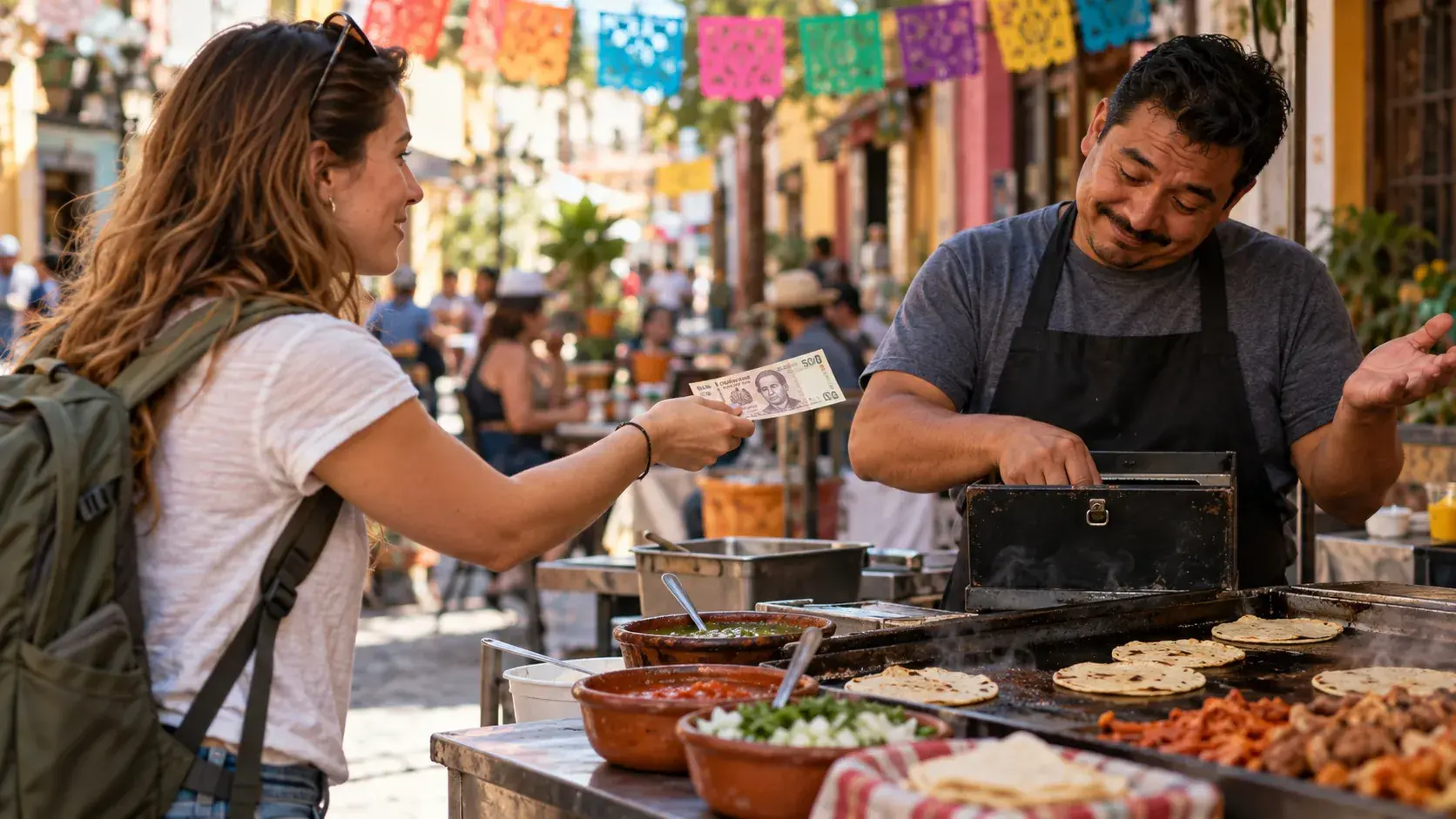
You order tacos, get in a taxi or buy fruit at the market, hand over a 500-peso bill, and the seller says: "No tengo cambio." It's one of the most common phrases you'll hear when paying in Mexico, and it usually comes with a quick follow-up question you need to understand.
This guide explains what it means, what people say next, and simple Spanish you can use to solve the problem on the spot.
What "No tengo cambio" means
No tengo cambio means "I don't have change." The seller isn't refusing to sell to you. They just can't break the bill you gave them, so they need a smaller bill, the exact amount, or another way to pay.
You'll hear it most often:
- In taxis, especially at the start of a shift
- At street food stands and small fondas
- In markets and tianguis (street markets)
- At small corner stores early in the morning
- When you pay a small amount with a 500 or 1,000-peso bill
What the seller may ask you next
After no tengo cambio, the conversation usually continues with one of these questions:
| They say | Meaning | You can answer |
|---|---|---|
| ¿No tiene más chico? | Don't you have a smaller bill? | Sí, aquí tiene. / No, nomás traigo de quinientos. |
| ¿No trae de cien? | Do you have a 100? | Déjeme ver. (Let me check.) |
| ¿Tiene exacto? | Do you have the exact amount? | Sí, aquí está. / No, perdón. |
| ¿No tendrá cinco pesos? | Would you have 5 pesos? | Sí, tome. |
| Ahorita le cambio. | I'll get change for you in a moment. | Está bien, gracias. |
| No hay cambio. | There's no change. | ¿Acepta tarjeta? |
The question "¿No tendrá cinco pesos?" confuses a lot of visitors. The seller is asking for a few extra pesos so they can give you rounder change, like a single 20 or 100 bill instead of lots of coins. You'll see an example in the second dialogue below.
Useful phrases to solve the problem
| Spanish | English | When to use it |
|---|---|---|
| ¿Tiene cambio de quinientos? | Do you have change for 500? | Before you order or get in a taxi |
| Nomás traigo billetes de quinientos. | I only have 500 bills. | To explain your situation |
| ¿Acepta tarjeta? | Do you take card? | When you have no cash option |
| ¿Me puede cambiar este billete? | Can you break this bill? | At a store or cash register |
| Voy a cambiarlo y regreso. | I'll go break it and come back. | When the seller has no change |
| ¿Dónde puedo cambiar un billete? | Where can I break a bill? | To ask for a nearby store |
| Quédese con el cambio. | Keep the change. | When the change is small |
Nomás is a very Mexican way to say solo (only). You'll hear it everywhere, and using it sounds natural.
Cambio, suelto, vuelto, feria and morralla
Different Spanish-speaking countries use different words for change. Here's what you'll hear in Mexico:
| Word | Meaning | In Mexico |
|---|---|---|
| cambio | change you get back | The standard word; you'll hear it most |
| suelto | small bills or coins | Understood and used |
| vuelto | change you get back | More common in other countries; in Mexico people usually say *cambio* |
| feria | small change, coins, money (informal) | Very Mexican: *¿Traes feria?* |
| morralla | loose coins (informal) | Mexican slang, common in markets |
| billete más chico | smaller bill | Very common |
Remember that cambio also means currency exchange. A casa de cambio is a place to exchange dollars for pesos, not a place to break a bill.
Dialogue 1: in a taxi
Driver: Son ochenta pesos. (It's 80 pesos.)
You: Nomás traigo de quinientos. ¿Tiene cambio? (I only have a 500. Do you have change?)
Driver: No, joven, no tengo cambio. ¿No trae más chico? (No, I don't have change. Don't you have a smaller bill?)
You: No, lo siento. ¿Acepta tarjeta? (No, sorry. Do you take card?)
Driver: No, puro efectivo. (No, cash only.)
You: ¿Podemos parar en un Oxxo? Cambio el billete y le pago. (Can we stop at an Oxxo? I'll break the bill and pay you.)
Driver: Sí, ahí en la esquina hay uno. (Yes, there's one on the corner.)
Dialogue 2: at a taco stand
Your total is 85 pesos and you pay with a 200-peso bill.
Taquero: Son ochenta y cinco. (It's 85.)
You: Aquí tiene. (Here you go.) — you hand over 200
Taquero: ¿No tendrá cinco pesos? (Would you have 5 pesos?)
You: Sí, tome. (Yes, here.)
Taquero: Entonces le doy ciento veinte. (Then I'll give you 120.)
Paying 205 instead of 200 means the change is exactly 120, so the seller can give you a 100 and a 20 instead of hunting for coins. If you don't have the coins, just say "No, perdón" and wait for your change. For more phrases at food stands, see how to order food in Mexico.
How to avoid "no tengo cambio"
- Break big bills at chain stores. Convenience stores like Oxxo, supermarkets and pharmacies usually have change. Buy a water or a snack and pay with the large bill.
- Keep small bills and coins apart. Save 20s, 50s and coins for taxis, markets, tips, parking and public restrooms.
- Ask before, not after. "¿Tiene cambio de quinientos?" before a taxi ride or a big order saves an awkward moment.
- Try an odd ATM amount. Many ATMs give out 500-peso bills. Withdrawing an amount like 1,900 instead of 2,000 can help you get some smaller bills.
- Don't count on cards at small places. Cards are common in chains and city restaurants, but street stands, markets and many taxis are often cash only.
If someone asks you for change
Sometimes the situation is reversed and someone asks if you can break a bill. If you can't, say:
- Perdón, no traigo cambio. (Sorry, I don't have change.)
- Nomás traigo billetes grandes. (I only have big bills.)
If you're not sure how much Spanish you need for moments like this, read how much Spanish you need to travel to Mexico.
Frequently asked questions
What does "no tengo cambio" mean in Mexico?
It means "I don't have change." The seller can't break the bill you gave them, so they need a smaller bill, the exact amount or another form of payment.
Is it rude to pay with a 500-peso bill in Mexico?
It isn't rude, but at small stands, markets and taxis it often causes a problem for small purchases. Ask "¿Tiene cambio de quinientos?" first, or break large bills at chain stores.
What's the difference between cambio and vuelto?
Both mean the change you get back. In Mexico people usually say "cambio," while "vuelto" is more common in other Spanish-speaking countries, though Mexicans will understand it.
What does "¿no tiene más chico?" mean?
It means "Don't you have a smaller bill?" You can answer "Sí, aquí tiene" if you do, or "No, nomás traigo de quinientos" if you only have a 500.